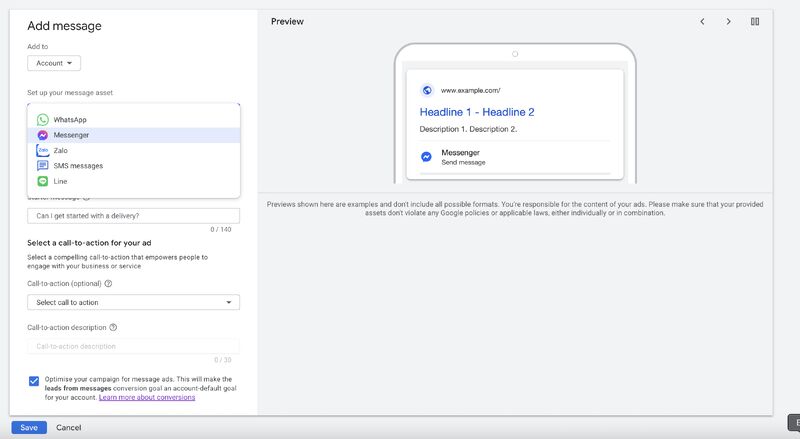
Google Ads Messenger integration could change how businesses turn search traffic into real customer conversations. Google is testing the ability to let advertisers connect campaigns with Facebook Messenger or text messaging, potentially giving customers a more direct way to engage with businesses after seeing an ad.
The reported testing allows these messaging options to be configured at the account, campaign, or ad group level, giving advertisers more control over where and how conversations can be initiated.
From clicks to conversations
Traditionally, the Google Ads journey looks something like this:
Search → Ad → Website → Form → Lead
Messaging introduces another possible route:
Search → Ad → Message → Conversation → Lead
That difference could be significant.
A customer searching for a service may not be ready to complete a form, but they may be willing to send a quick message asking about pricing, availability, delivery, location, or the next step.
For businesses, that conversation can become an important part of the sales process.
Why Google Ads messaging matters
One of the biggest challenges in digital advertising is turning interest into action.
Getting someone to click an advertisement is only the beginning. The real value comes when that visitor becomes a qualified lead or customer.
Messaging could help reduce some of the friction between discovering a business and contacting it.
For example, a person searching for car dealers in Kenya could see an advertisement and immediately choose to start a conversation rather than navigating through multiple pages before finding a contact option.
This could be especially useful for businesses where customers typically have questions before making a decision.
A new opportunity for lead generation
If messaging becomes more widely available within Google Ads, marketers may need to rethink how they define campaign success.
Instead of focusing primarily on:
- Impressions
- Click-through rate
- Website traffic
- Cost per click
marketers could increasingly pay attention to:
- Number of conversations
- Cost per conversation
- Qualified enquiries
- Response time
- Leads generated
- Conversion from conversation to customer
This creates a more complete picture of advertising performance.
What businesses need to prepare for
Launching messaging as an advertising option is only one part of the equation.
Businesses also need to be ready to respond.
If an advertisement generates 50 conversations but the business takes hours to respond, the opportunity can quickly disappear.
Businesses considering conversational campaigns should have:
A clear response process: Customers should know they are talking to the right team.
Fast response times: Speed matters when someone has just shown buying intent.
Consistent messaging: Sales teams need clear information about products, services and pricing.
Lead tracking: Conversations should be connected to the wider sales process.
Strong follow-up: Not every customer will buy during the first conversation.
What this means for digital marketers
This development highlights a bigger shift in digital marketing.
The focus is moving from simply generating traffic to creating intent-driven customer journeys.
A successful campaign may no longer be about getting the highest number of clicks. It may be about generating meaningful interactions that eventually result in business.
For digital marketers, this means thinking beyond the advertisement itself and looking at the entire journey from search to conversation to conversion.
The future of Google Ads could be more conversational
Google Ads has traditionally been one of the strongest tools for capturing people who are actively searching for products and services.
Adding messaging into that journey could make the experience more immediate.
The important question for businesses will not simply be, “How many people clicked our ad?”
It will increasingly be:
“How many of those people started a meaningful conversation with us?”